


Welcome to Your Doctor Friend. I’m Mara, a family physician, mom, and writer. (Among other things! We contain multitudes!) I write about navigating health care, dismantling diet culture, and desperately keeping it together as a doctor mom. Thanks for being here.

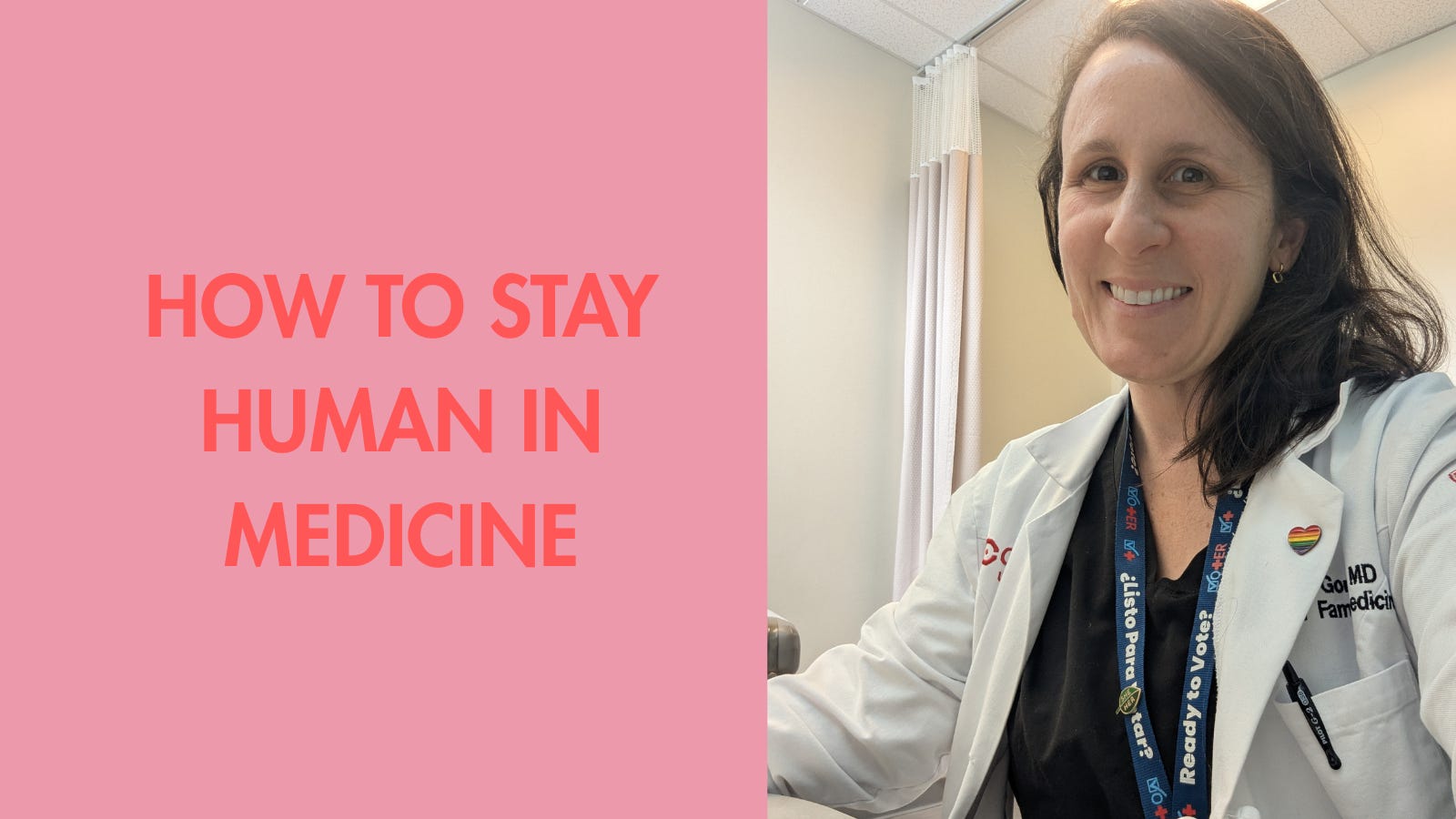
At a family wedding earlier this summer, I met my cousin’s partner for the first time, a young woman who was currently applying to medical school. I told her how excited I was for her and offered to talk on the phone about the application process. And you know what she said to me?
“Thank you for not telling me I’m making a huge mistake,” she told me.
Apparently, she confided, almost every doctor she met tried to talk her out of applying. I was shocked. I have my fair share of gripes about modern medicine, but I’d never tell a young person I just met she was making a terrible life decision.
And more importantly, I don’t think a career in medicine is a terrible life decision. I think it’s a career that can have profound meaning – and at times, it’s “just a job” that has plenty of mundane tasks. No profession is fun every second of every day. But I still think a career in medicine has many, many rewards.
I recently had the honor of giving our medical school’s white coat ceremony speech, where I got to think more seriously about the next generation of physicians. A white coat ceremony is an event that welcomes brand-new medical students to the profession; they receive their first white doctors’ coats and recite the Hippocratic oath. The ceremony was conceived of in the 1990s by the Arnold P Gold Foundation, an organization dedicated to cultivating humanism in medicine, and nowadays, almost all medical schools hold one at the beginning of the school year.
Giving this talk was a big ask. I was proud to be chosen, but I was also nervous about doing right by the students. I wanted to walk a fine line between enthusiasm for the field of medicine and acknowledgment that our profession is facing serious existential challenges. Here, I share what I told the class of 2030.

To the class of 2030: Welcome, Future Doctors. To your families, your friends, and the communities that will support you down the exciting road ahead: thank you for being here, too. On behalf of the faculty, I am honored to welcome you, as colleagues, to the field of medicine. Thank you to the dean and the chancellor for inviting me to speak to you all today.
When I was a medical student, I always hated it when my professors told me and my classmates how smart we were. It stressed me out! It made me feel like something was wrong with me if medical school wasn’t easy – and, shocker, it was not easy. When I failed an exam during my first year of medical school, I felt so much shame. I thought I wasn’t cut out to be a doctor. But over time, I’ve come to realize that being a doctor is not about being a genius – because, unfortunately, I am not one, nor do I really believe genius exists – but it’s about having a sense of curiosity about the world around you, asking for help when you need it, and doing the unglamorous, day-in, day-out work of learning.
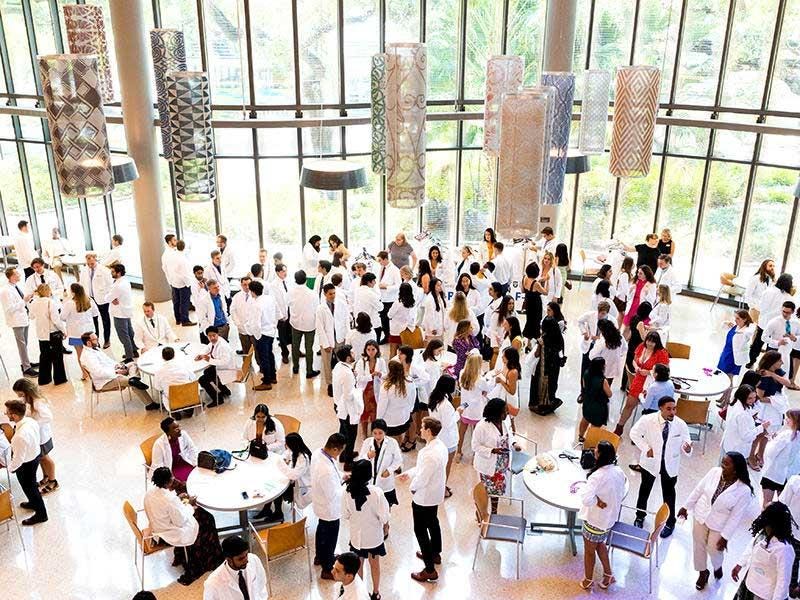
So, instead of telling you all how smart you are – and you are very smart – I will instead remind everyone here how kind, compassionate, and giving you are. You have founded organizations that help your communities, volunteered your time and expertise to people who need your help, and shown so much care and compassion to those who are vulnerable. Those are the traits that will serve you well as you embark on this exciting next step towards becoming physicians.

I’m talking to you today in the midst of a difficult summer for me and my family. Both of my parents have serious neurodegenerative diseases that have worsened in the last few months; my mom has Parkinson’s, and my dad lives with advanced Alzheimer’s. My mom is a psychiatrist, and I remember vividly standing with her at my own white coat ceremony, fifteen years ago, reciting the Hippocratic oath together. I thought she looked so elegant. I was proud to be joining the same profession as someone I admired so much.
This past June, after a few months of worsening symptoms, my mom became confused, and then she had a fall. She was admitted to the hospital where I did my residency. It’s where I worked many overnight shifts, and where I learned how to be a doctor. It’s also where I consumed many “Presby cocktails” – a snack that will become familiar to you in a few short years, when you’re working in the hospital. It’s a mixture of cranberry juice and ginger ale, paired with an appetizer of graham crackers and a single-serving peanut butter, all assembled from the snack closets on the medical floors.
It wasn’t a happy homecoming for me to be back there. I couldn’t help but want to be my mom’s doctor, but I wasn’t. I am her daughter, and it was painful to watch her lying in her hospital bed, confused and uncomfortable, knowing there wasn’t much I could do. We waited for many long hours. There were doctors who looked more at their computers than at my mom. There was endless bureaucracy that made me fear she would never get the care that she needed. In my darkest moments, I thought to myself: how could I work in a system with so many flaws?
But then I met my mom’s certified nursing assistant. CNAs, as they’re known, are the backbone of the hospital and, arguably, those who work most closely with patients. They take vital signs, help feed and bathe patients, and help them use the bathroom. The CNA who helped my mom for most of her hospital stay was a young woman I’ll call Aliyah. I could immediately sense that she felt a calling to care for her patients.
Aliyah was probably in her 20s. She had a big smile on her face and always looked my mom in the eye. She asked questions about my mom’s life. As my mom regained her mental clarity, they had a funny conversation about my mom’s love of pug dogs. Most importantly, she acted like my mom was a person, not just a task to complete.
I know, from working in hospitals, that the work of CNAs is historically undervalued and underpaid. When I say “Aliyah had a calling,” I use that word with some trepidation. I find that when people talk about your profession being a “calling,” they’re often trying to get you to do extra work without paying you for it. I didn’t actually ask Aliyah if she felt a calling to be a caregiver. What I mean is that, as I got to know her over my mom’s long days and nights in the hospital, I could see that she found meaning in her work. She took pride in being kind.
Aliyah was the one most present with my mother during her hospital stay. She was the one who helped adjust my mom in bed when she was uncomfortable. She helped move my mom’s iPhone so she could reach it and Facetime with her grandchildren. Aliyah helped do the most intimate task of bathing her body.
She treated my mom with dignity and compassion. She embraced the fact that her work was, as its core, about empathy. Aliyah remembered the most critical element of working in medicine, of helping others heal from illness: what matters is being a human, connecting with other humans.
And in a time when I felt very bleak, confronting my mother’s mortality and my own, Aliyah helped me feel some hope.

There are a lot of powerful forces threatening to strip away our humanity in health care. We are under unprecedented corporate pressure. Even the most idealistic doctors find themselves beholden to productivity spreadsheets that turn our patients into profits for those in power. We are practicing medicine in an era of extraordinary scientific progress, yet the color of your skin or the zip code you were born in can determine if you’re allowed to access care. The field of medicine, stubbornly, continues to reflect the inequality that plagues our culture at large.
But two things can be true at once: Doctors can be facing existential challenges to the integrity of our field, and we can still seek out our shared humanity with others in the face of those threats. That’s what Aliyah reminded me. She was working in a deeply flawed health care system, and she chose to be kind. I can do the same. You can do the same.
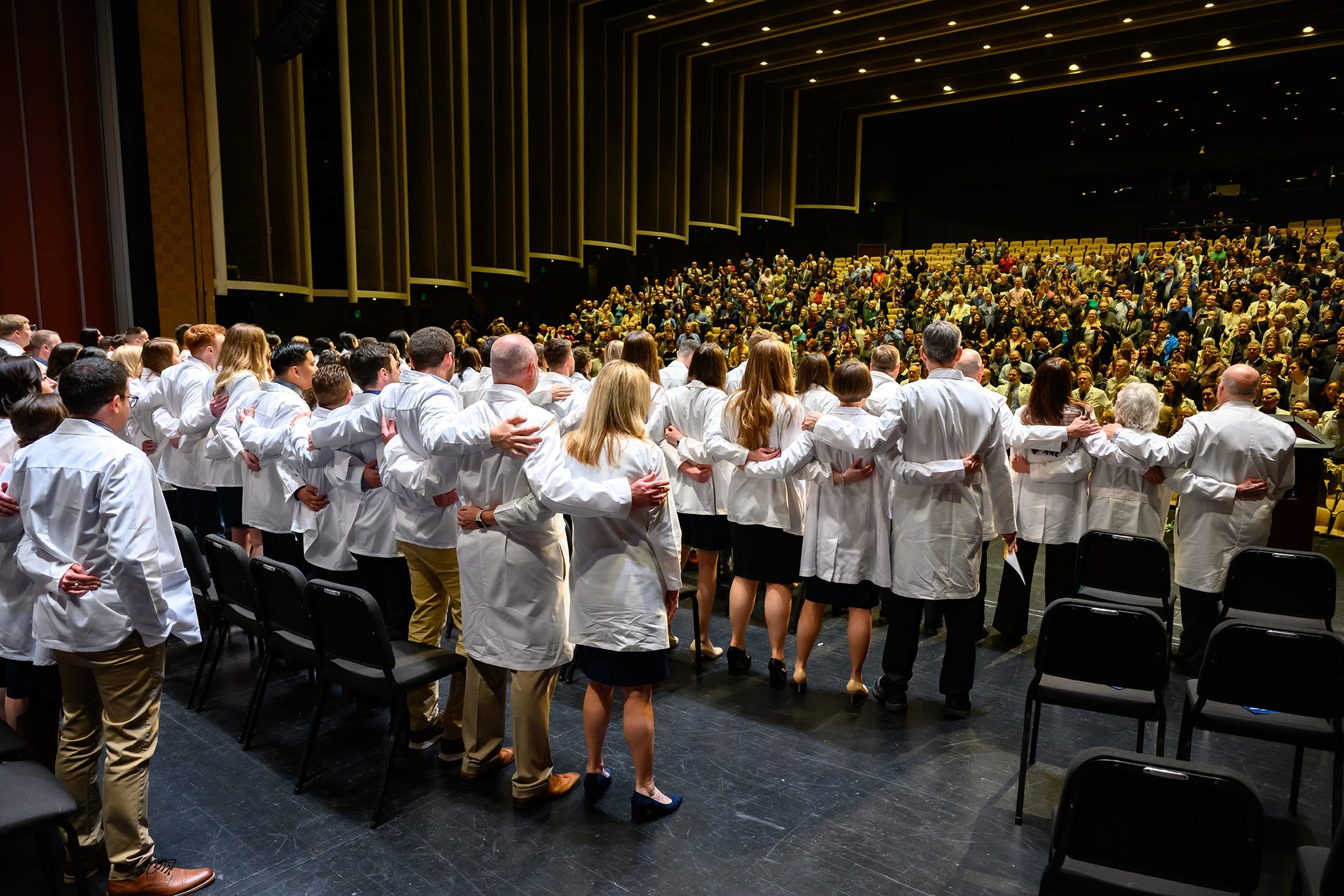

So to you, the class of 2030, I offer five profoundly unscientific tips about staying human throughout your training, even in a system that doesn’t always want you to be.
Be open to patient stories. When you have a million things on your to-do list, listening to a patient talk about their grandchild or the years they spent as a high school teacher can feel like a waste. But if you open yourself, just a little bit, to the richness of your patients’ lives, you will be immensely rewarded. These stories can’t be quantified or measured with a blood test; they may not make it into the medical record. Yet listening to them – deeply listening – will make you a better doctor who makes better decisions. It also makes medicine so much more fun.
There usually isn’t one right answer. In the coming years, you will be taking many, many exams where there is only one correct answer to each multiple choice question. Occasionally, that’s true in clinical medicine: An appendectomy treats appendicitis. But that’s the exception, not the rule. In real life, there’s rarely one right answer. Being able to sit with uncertainty will allow you to navigate difficult moments alongside your patients.
Empathy is your superpower. There is a lot of talk about artificial intelligence in medicine. I love my AI scribe, who lives in my phone. She joins me in my primary care visits to record my conversations with patients and then writes notes for me in the medical record. But as doctors grapple with whether or not we are going to be replaced by robots, I remember that empathy is a human experience. ChatGPT can mimic it, but there is nothing – nothing – that can replace sitting with your patient, looking them in the eye, and saying truthfully, “I am here with you.”
Advocacy can bring meaning to your work. I’ve thought of myself as a writer my whole life, but it wasn’t until I was a medical student, and I had my first professional publication, that I started to understand how for me, writing was about advocacy – and advocacy enriched my life in so many unexpected ways. As a physician writer, speaking out about the injustice I witnessed gave me a sense of purpose. Being a writer makes me a better doctor, and being a doctor makes me a better writer. You may find your advocacy takes different forms – you may do research that advances technology in your field, you may serve a vulnerable community, you may give back by teaching the next generation of doctors. Whatever you choose, I know that working to make our system better makes us better, too.
Seek out happiness and fun. Orienting ourselves to joy can help us retain our humanity. That can take many forms – joy isn’t always found at big, milestone occasions. You can discover it in the mundane, routine moments that make up a life. In my clinic, for example, we eat a lot of cake – we like any excuse to celebrate. Birthdays, holidays, Wednesdays. (I’m telling you now, you should request my clinic for your family medicine rotation – we really do eat a lot of good food, and med students are always invited to the party.) Seeking out happiness can also mean prioritizing parts of yourself that exist outside of work. In addition to being medical students, you all are someone’s child, sibling, friend, or significant other. Perhaps some of you are parents. Treat those identities with as much care as you treat your role as medical students.

The day my mom was discharged from the hospital, she was fearful about the future. I was fearful, too. I knew that things wouldn’t be the same. My mom would be discharged to a rehabilitation facility, and then onwards to an assisted living community.
Aliyah came to say goodbye as two men from a medical transport company got ready to wheel my mom to the van waiting outside. She gave me and my mom both a hug. I noticed she didn’t offer any cliches like, “It’ll all be okay.” or “You’ll get better.” She had too much experience working in the hospital for that. She knew my mom might not get better.
Instead, she said, “It was nice to get to know you.”
To the class of 2030: I wish you all the best as you embark on this exciting journey. The field of medicine faces many challenges, and I know you are up to the task of addressing them. Congratulations, doctors-to-be, and good luck.

I’d love to hear: How do you stay human in your workplace?

My book HOW TO TAKE UP SPACE is about diet culture in medicine and it’s coming in Spring 2027. Stay tuned to Your Doctor Friend for updates.
Beautiful Mara! And I always struggle with how to answer when people ask me about going into medicine, less now than a couple years ago when I was just feeling so bitter and abandoned from the pandemic. Where I've come to is to ask them if they feel they could work in the healthcare system as it is, if nothing got fixed. Because I think that is something I've really struggled with, in the hubris of being 22, I figured that the reason things were so dysfunctional was the people working in the field just didn't know it was a problem or hadn't tried to fix it in the right way? I don't know exactly, but I thought it could be fixed and I could be a meaningful contributor to fixing it. Neither of those have come to pass thus far, with a result of some substantial disillusionment on my part :)
Procrastinating at doctor work by reading this, haha! Thank you for the lovely words and re-grounding. I am a physician-writer hoping to transition to writer-physician in the next few years. I still find (relative) passion in both, but writing better fits my sloppy outfits. I work in college health and have the privilege of having young people both as patients and mentees. Like you, I still absolutely encourage folks to pursue medicine but love asking reflective questions, sharing about all the different ways care, healing, support can look (both within our profession, adjacent to our profession - midwives, NPs, etc, but also "outside" of it, just to give options for them to nurture this gorgeous, giving, earnest part of themselves). Lucky us to enjoy their youthful wisdom and ideas. Onward onward fellow writer! So glad I found your substack (via The Vajenda, among the best in the biz)